
The 5 Laws of Building Real Wealth
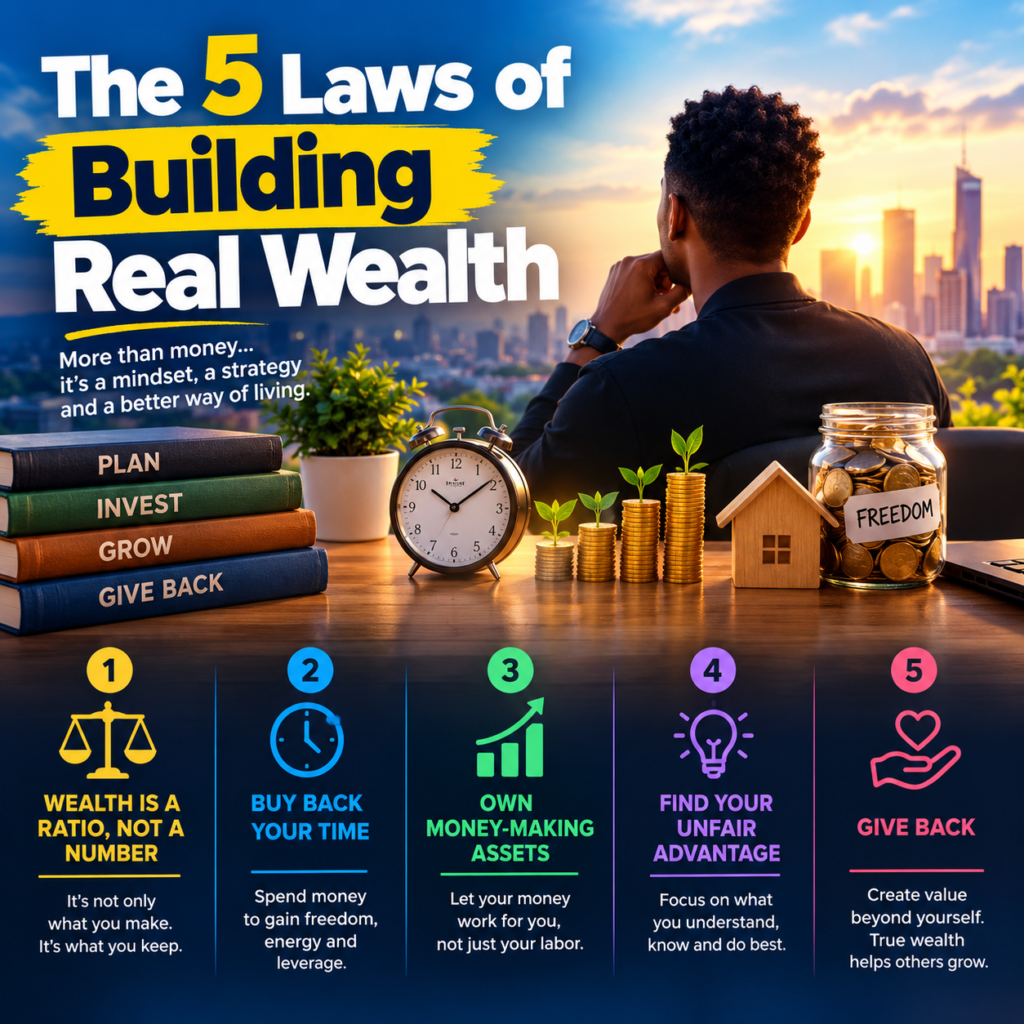
Many people believe that becoming wealthy is simply a matter of following the right money rules: save more, invest more, earn more, and spend less.
Those principles can certainly help, but they don’t tell the whole story.
Real wealth is less about following a list of rules and more about understanding a few fundamental principles that determine whether your money grows, whether your time remains yours, and whether your financial progress lasts.
Here are five powerful laws that can reshape the way you think about building wealth.
1. Wealth Is a Ratio, Not a Number
A high income doesn’t automatically make someone wealthy.
What matters is the relationship between what you earn and what you spend.
Someone earning $80,000 a year and spending $50,000 may have considerably more financial flexibility than someone earning $300,000 while spending $290,000.
This is why lifestyle inflation can be so dangerous. As income increases, people often increase their spending just as quickly. A more expensive car, larger home, designer clothing, expensive vacations, and other upgrades can consume nearly every additional dollar they earn.
The result is that their financial position barely improves despite earning much more.
The fundamental principle is simple:
It’s not only what you make. It’s what you keep.
To build wealth, create a meaningful gap between your income and your expenses.
That gap gives you money that can be saved, invested, or used to create additional sources of income.
The goal isn’t necessarily to live an extremely cheap life forever. Instead, become intentional about when and why you increase your lifestyle.
Build the financial foundation first. Then allow your lifestyle to grow from a position of strength rather than debt and financial pressure.
2. Buy Back Your Time
One of the biggest mistakes people make as their income increases is buying more things instead of buying more freedom.
There’s nothing inherently wrong with owning a nice car, having a beautiful home, or enjoying expensive experiences. The problem begins when those purchases consume resources that could have been used to create greater wealth.
Think about purchases differently.
Instead of asking:
“What can I buy?”
Ask:
“What can I buy that gives me more time, energy, or leverage?”
Time is one of the most valuable assets you have because you can never create more of it.
If you can spend money to eliminate repetitive tasks, you may be able to use those recovered hours for activities that produce considerably more value.
The Buy-Back Loop
A practical way to do this is to follow three steps.
Step 1: Audit
Look at your calendar from the past two weeks.
Identify the activities that:
- Give you energy
- Drain your energy
- Generate income
- Help you grow
- Are repetitive
- Could easily be handled by someone else
This gives you a clearer picture of where your time is actually going.
Step 2: Transfer
Look for tasks that don’t require your personal involvement.
These could include:
- Cleaning
- Meal preparation
- Administrative work
- Processing emails
- Repetitive business tasks
- Basic research
- Scheduling
- Other routine responsibilities
If someone else can do a task effectively for a reasonable cost, consider delegating it.
Technology and AI can also help automate or simplify many repetitive activities.
A useful technique is to record yourself performing a task. That recording can become instructions for someone else, allowing them to understand exactly how you want the task completed.
Step 3: Fill
Getting your time back isn’t enough.
You have to use that time intelligently.
Put those recovered hours toward activities that can increase your income, skills, relationships, business, or long-term opportunities.
For entrepreneurs, that might mean focusing more on:
- Sales
- Strategy
- Hiring
- Leadership
- Relationships
- Business development
- Learning valuable skills
- Creating new opportunities
The purpose of buying back your time isn’t simply to become less busy.
It’s to make your time more valuable.
Instead of immediately spending money on a luxury purchase, consider whether that money could first create leverage that eventually makes the luxury purchase much easier to afford.
3. Own Money-Making Assets
The third law is to stop thinking only about earning money through your labor and start thinking about owning assets that can generate wealth.
Ask yourself:
“If I stopped working today, would my income stop?”
If the answer is yes, most of your financial life may still depend on your time.
The wealth-building goal is to gradually acquire assets that can produce value without requiring you to personally work every hour.
These can include things such as:
- Business ownership
- Equity in companies
- Stocks
- Real estate
- Other productive investments
The exact investments that make sense will depend on your circumstances, knowledge, risk tolerance, and financial goals.
The broader principle is ownership.
When you own part of a productive asset, you can potentially benefit from its growth and income rather than relying entirely on wages or fees.
Time vs. Equity
A simple exercise can help you understand where your money comes from.
Create two columns: Time Equity Salary Business ownership Hourly work Stocks Consulting Real estate Freelancing Other productive assets
Now list your sources of income.
Ask yourself whether each source requires you to continue working in order for the income to continue.
If you stop working and the income immediately stops, it belongs primarily on the time side.
If the asset can continue producing value without your constant involvement, it belongs closer to the equity side.
The objective isn’t necessarily to eliminate work.
It’s to gradually build ownership alongside your earned income.
Build a Business That Has Value Without You
A business can initially depend heavily on its founder’s time.
But a strong business can eventually develop systems, employees, processes, customers, intellectual property, and brand value that make it less dependent on the founder.
That’s when a business can become an asset rather than simply another job.
This distinction is important.
If you build a company that only works when you personally do everything, you’ve created employment for yourself.
If you build a company that can operate and create value beyond your individual labor, you’ve created something that may have significant equity value.
4. Find Your Unfair Advantage
Everyone has a combination of knowledge, experience, interests, skills, relationships, or perspectives that can become an advantage.
Your job is to identify yours.
Perhaps you’ve spent years working in a particular industry.
Maybe you’ve experienced a problem personally and understand it better than someone who has never experienced it.
Maybe you have technical skills, business knowledge, creative abilities, industry connections, or a deep understanding of a particular market.
That accumulated knowledge can become extremely valuable.
Stick to What You Understand
One of the biggest investment mistakes is putting money into opportunities simply because they sound profitable.
Someone may present an exciting restaurant business.
Another person may present a technology startup.
Someone else may offer an attractive real-estate opportunity.
The potential returns might sound incredible, but potential profit isn’t enough.
If you don’t understand the business, the market, the risks, or the underlying economics, you may be relying on someone else’s confidence rather than your own knowledge.
A bad investment can happen when you chase opportunities outside your area of understanding.
Instead, develop your circle of competence.
Ask yourself:
What do I understand unusually well?
What problems have I experienced personally?
What industries have I spent years learning about?
What products or businesses do I naturally understand?
Where can my knowledge give me an advantage?
This doesn’t mean you should never learn something new.
It means you should be careful about putting significant money into things you don’t understand simply because someone promises extraordinary returns.
Two Questions Before Investing
Before putting money into an opportunity, consider two simple questions:
- Do I have specific knowledge or meaningful understanding of this investment?
- Can I explain how it works in one or two simple sentences?
If you can’t explain the investment clearly, that may be a sign that you need to learn more before committing your money.
There will always be another opportunity.
You don’t need to invest in everything.
Sometimes wealth is built not only by knowing what to say yes to, but by becoming very good at saying no to things you don’t understand.
5. Give Back
The final law is different from the others.
Building wealth isn’t only about accumulating.
It’s also about what you do with the resources you eventually have.
Money is a flow.
It comes in, moves through your life, and can be used to create value for yourself, your family, your employees, your community, and other people.
A person can spend their entire life accumulating money and still feel financially insecure because they’re constantly focused on protecting what they have.
Giving can create a completely different relationship with wealth.
And giving doesn’t only mean money.
You can give:
- Your time
- Your knowledge
- Your skills
- Your connections
- Your influence
- Your resources
- Your encouragement
You don’t need to be wealthy before you start contributing.
In fact, developing the habit of giving when you have relatively little can help establish a mindset of abundance rather than scarcity.
Give With Intention
A practical place to begin is to identify a cause that genuinely matters to you.
Think about the problems you understand deeply.
Perhaps you’ve experienced a difficult period in your life, watched someone close to you struggle, or simply care deeply about a particular issue.
Find organizations or people working to address that problem and contribute in whatever way you realistically can.
If you don’t have money, give your time.
If you have money, you can potentially give both money and time.
The important thing is that your contribution is intentional.
Move Beyond Scarcity
Giving can sometimes trigger uncomfortable thoughts:
“I don’t have enough.”
“I could use this money for myself.”
“What if I need it later?”
These concerns are understandable, especially when resources are limited.
But building wealth should not mean living permanently from a mindset of fear.
The long-term goal is to develop the ability to create more value, earn more, invest wisely, and contribute more.
The more capable you become of creating value, the more capable you can become of helping others.
Bringing the Five Laws Together
These five principles work best when they’re combined.
First, create a gap between what you earn and what you spend.
Without that gap, there is little capital available to build wealth.
Second, use money to buy back valuable time.
Reduce low-value activities so you can focus your time on things that create greater value.
Third, turn earned income into ownership.
Build or acquire assets that can potentially generate income and appreciate in value without requiring your constant labor.
Fourth, use your unfair advantage.
Focus on areas where your knowledge and experience give you a genuine edge, and avoid blindly chasing opportunities you don’t understand.
Fifth, give back.
Use your growing resources to create positive impact beyond yourself.
This creates a different definition of wealth.
Wealth isn’t simply having an impressive bank balance or owning expensive things.
Real wealth can mean having control over your time, owning productive assets, understanding how to create value, and having the ability to help other people.
A Simple Wealth-Building Exercise
You don’t need to completely transform your financial life overnight.
Start by taking one hour and answering these questions:
1. What is my wealth ratio?
How much do I earn each month, and how much do I actually spend?
2. Where is my time going?
Which activities consume time without creating meaningful value?
3. What can I delegate or automate?
Which responsibilities could someone else—or technology—handle?
4. What assets do I own?
Which of them can potentially generate income or grow in value without requiring constant work?
5. What is my unfair advantage?
What knowledge, skills, experiences, or interests do I understand better than most people?
6. What am I investing in?
Do I genuinely understand the things I’m putting my money into?
7. What am I giving?
How are my time, skills, money, or influence helping other people?
Your answers can reveal exactly where your financial life currently stands and what needs to change.
Final Thoughts
The path to wealth isn’t simply about making more money.
It’s about what happens after you make it.
If your income increases but your expenses rise at the same speed, you’re not creating much financial freedom.
If you earn more but remain trapped by your schedule, you’re still selling your most limited resource: your time.
If you work hard but never acquire ownership, your wealth may remain dependent on your labor.
If you invest without understanding what you’re buying, higher income can simply give you more money to lose.
And if you accumulate everything without ever using your resources to help others, you may miss one of the most meaningful benefits of having wealth in the first place.
The objective is to create a system where you earn, keep, leverage, own, understand, and give.
Start small.
Increase the gap between what you earn and what you spend. Buy back some of your time. Begin building ownership. Develop your unique advantage. And find ways to contribute to other people.
The rules can change.
But these principles can provide a lasting foundation for building real wealth.

Author: Fernandez Alexandra
Am a blog write