
How to Switch From Watching to Creating: A Practical Guide to Becoming a Creator
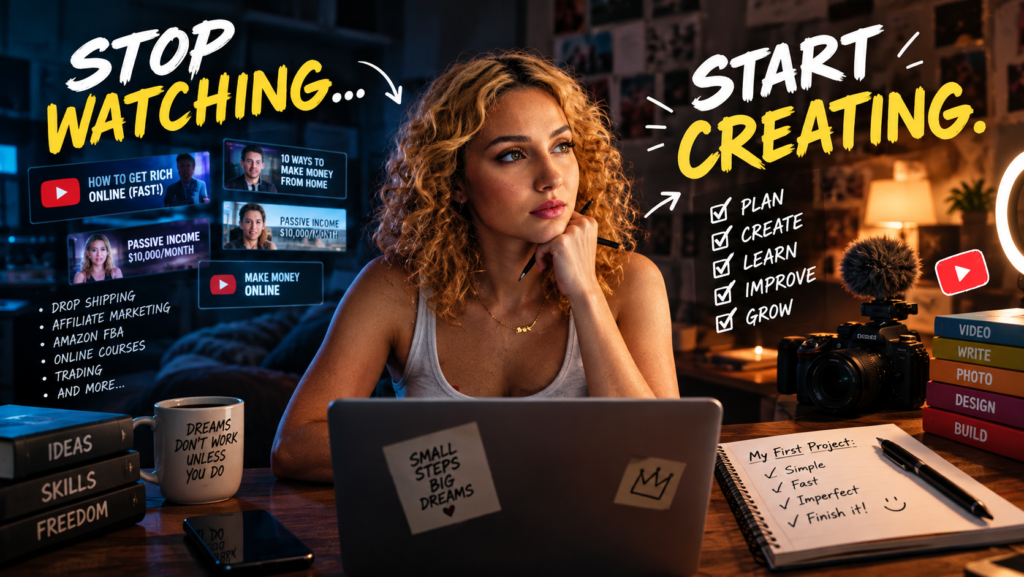
It is easy to spend hours watching other people create.
You watch videos about filmmaking, writing, business, photography, music, coding, design, or whatever interests you. You save tutorials. You subscribe to creators. You collect ideas. You tell yourself that you are learning.
And technically, you are.
But eventually, there is a problem.
You have watched hundreds of videos, yet you have created almost nothing.
You keep thinking:
“I want to start, but I don’t know what to make.”
“I haven’t found my style yet.”
“I don’t know what my voice is.”
“I’m not good enough.”
“Maybe I need better equipment.”
“Maybe I should learn a little more first.”
“I’ll start when I have a better idea.”
The problem is that there will probably never be a perfect moment.
You don’t discover your creative voice before you start creating. You discover it by creating.
The fastest way to move from being a consumer to becoming a creator is not to wait until you feel ready. It is to start making small things, learn from what you make, and repeat the process.
This guide explains how to make that transition without needing expensive equipment, a perfect idea, or years of experience.
1. Stop Waiting to Discover Your “Voice”
One of the biggest reasons people don’t start creating is that they think they need to know who they are first.
They want a recognizable style.
They want a unique perspective.
They want a specific niche.
They want to know exactly what kind of creator they are going to become.
But almost nobody starts with a fully developed creative identity.
Your style is usually the result of hundreds of small decisions you make over time.
Think about a filmmaker who has made 500 videos.
Their 500th video might have a recognizable style, but their first video probably didn’t.
The same is true for writers, photographers, musicians, designers, YouTubers, entrepreneurs, and artists.
Your voice is built through practice.
You don’t sit in a room and think hard enough until your unique style suddenly appears.
You make something.
Then you make another thing.
You notice what you enjoyed.
You notice what you disliked.
You discover what you’re naturally good at.
You experiment with different approaches.
Eventually, certain patterns start appearing.
Those patterns become your style.
So instead of asking:
“What is my creative voice?”
Ask:
“What can I make today?”
That is a much more useful question.
2. Start by Studying the People You Admire
If you don’t know what to create, look at the creators whose work you already love.
This doesn’t mean copying someone’s work and pretending it is your own.
It means studying how they think.
Every creator starts somewhere. Most learn by observing other people.
If you love a particular filmmaker, study their films.
If you love a particular writer, study their articles and books.
If you love a YouTuber, study their videos.
If you love a photographer, study their photographs.
Ask yourself:
- Why does this work interest me?
- What makes it memorable?
- How does it begin?
- How does it keep my attention?
- What emotions does it create?
- How does the creator structure the work?
- What decisions make it different from ordinary content?
- What can I learn from it?
This is much more valuable than simply saying:
“I like this.”
Try to understand why you like it.
That is where the real learning happens.
3. Don’t Copy the Surface—Copy the Thinking
There is an important difference between copying someone’s style and learning from someone’s approach.
Imagine you love a particular filmmaker because their movies have dark lighting.
You could copy the dark lighting.
But that doesn’t necessarily make your work good.
Instead, ask why they use that lighting.
Maybe it creates tension.
Maybe it makes the characters feel isolated.
Maybe it supports the emotional tone of the story.
Once you understand the reasoning behind the decision, you can use the same principle in your own way.
The goal isn’t to become your favorite creator.
The goal is to understand how they see the world.
You aren’t trying to become a copy of your heroes.
You’re using their work as a way to learn.
And eventually, the combination of everything you’ve learned from different influences becomes something that belongs to you.
4. Build a Creative Idea Notebook
One of the simplest habits you can develop is keeping a place where you record ideas.
It could be:
- A notebook
- Your phone
- A notes app
- A document on your computer
- A private folder
- A spreadsheet
The tool doesn’t matter.
The important thing is that you don’t trust yourself to remember every idea.
Ideas disappear quickly.
You might suddenly think of an interesting video topic while walking somewhere. You might hear an interesting sentence. You might notice something that would make a great photograph. You might think of a story while taking a shower.
Write it down.
Don’t worry about whether the idea is good.
Your idea notebook isn’t a list of things you promise to make.
It is a collection of raw material.
Later, when you don’t know what to create, you can return to it.
You might find an idea you completely forgot about.
You might combine two unrelated ideas.
You might notice a recurring theme.
That’s how creativity often works.
You collect pieces, then eventually connect them.
5. Change Your Consumption-to-Creation Ratio
Watching other people create can feel productive because you’re constantly learning.
But there is a major difference between learning about something and actually doing it.
You can watch 100 videos about filmmaking without becoming a filmmaker.
You can watch 100 videos about writing without becoming a writer.
You can watch 100 videos about photography without becoming a photographer.
At some point, you need to put the information into practice.
A useful starting rule is to aim for roughly a 50/50 balance between consuming and creating.
If you spend an hour learning, try to spend an hour practicing.
Don’t become obsessed with making the ratio perfect. The point is simply to prevent learning from becoming an excuse for avoiding action.
Eventually, you may even find yourself creating more than you consume.
That’s a good sign.
Instead of watching another tutorial about how to make something, you start thinking:
“Let me try making it.”
That’s the transition from consumer to creator.
6. Stop Waiting for Perfect Equipment
Another common problem is believing you need better tools.
You might tell yourself:
“I need a better camera.”
“I need a better microphone.”
“I need a computer.”
“I need a proper studio.”
“I need professional lighting.”
Sometimes better equipment genuinely helps.
But it usually isn’t the biggest obstacle when you’re starting.
Your first goal isn’t to produce the greatest work you’ve ever seen.
Your first goal is to finish something.
If you have a phone, use your phone.
If you have a basic laptop, use your laptop.
If you have a bedroom, use your bedroom.
If you only have an hour, use the hour.
If you don’t have the perfect location, find a simple location.
Your first project doesn’t need to prove that you’re talented.
It needs to prove that you can start.
7. Limitations Can Actually Make You More Creative
Having unlimited options can sometimes make starting harder.
If you have every camera, lens, microphone, location, editing program, and possible subject available to you, you have thousands of decisions to make.
That can create paralysis.
A limitation gives you something to work with.
For example, you could decide:
- One camera
- One location
- One lens
- One subject
- One day to shoot
- Three minutes of finished video
Suddenly, you have fewer decisions.
And fewer decisions make it easier to act.
This principle applies far beyond filmmaking.
A writer could write a story using only 1,000 words.
A photographer could take ten photographs around their neighborhood.
A designer could create a poster using only two fonts.
A musician could make a short piece using only a few instruments.
The limitation becomes part of the challenge.
And sometimes the restriction forces you to become more inventive.
8. Make Your First Project Ridiculously Small
One of the worst things you can do as a beginner is make your first project enormous.
You decide you’re going to create a two-hour documentary.
Or write a 300-page book.
Or build the next major social media platform.
Or create a professional film.
Then reality arrives.
You realize how much work is involved.
You get overwhelmed.
You stop.
Instead, make the project so small that you can realistically finish it.
For example:
A 3–6 minute video.
A 500-word article.
A 10-photo series.
A one-page website.
A short story.
A simple illustration.
A five-minute podcast episode.
Your first project is not supposed to establish your career.
It’s supposed to teach you how to complete a project.
That distinction is extremely important.
9. Give Yourself a Deadline
Ideas can remain ideas forever if they don’t have a deadline.
You can spend six months researching a project without producing anything.
A deadline forces decisions.
Instead of saying:
“I’m going to make a video someday.”
Say:
“I’m going to publish one short video within the next 14 days.”
Now you have something concrete.
You have to choose a topic.
You have to create the outline.
You have to make the thing.
You have to finish it.
You have to publish it.
It may not be perfect.
That’s okay.
The objective is progress.
A short project that gets finished is more valuable than a brilliant project that never leaves your head.
10. Accept That Your First Work Might Be Bad
This is one of the hardest lessons for new creators.
You may have excellent taste but very little experience.
That creates a frustrating gap.
You know what good work looks like.
But when you try to make something yourself, it doesn’t look like the work you admire.
That’s normal.
Your taste is ahead of your ability.
The solution isn’t to stop.
The solution is to make more work.
Your first video might feel awkward.
Your first article might be poorly structured.
Your first photograph might look ordinary.
Your first business idea might fail.
Your first design might look amateur.
That’s part of the process.
Nobody becomes skilled without producing work that is worse than what they eventually create.
You don’t need your first project to be impressive.
You need it to exist.
11. Don’t Let Fear of Judgment Stop You
Once you start creating, another problem appears.
People might see it.
And suddenly, the project feels much more serious.
You start imagining what people will say.
“What if they laugh?”
“What if nobody likes it?”
“What if someone says it’s terrible?”
“What if people I know see it?”
These fears are incredibly common.
But remember something:
Most people are much less focused on you than you imagine.
They are busy thinking about themselves.
And even if someone dislikes your work, that doesn’t automatically mean the work has no value.
Feedback is part of becoming better.
Sometimes criticism teaches you something.
Sometimes it doesn’t.
Your job is to learn the difference.
Don’t allow the possibility of criticism to prevent you from ever producing anything.
12. Learn to Work While You’re Uncertain
Even experienced creators experience uncertainty.
They can sit down with a blank page and wonder whether the idea is good.
They can question their abilities.
They can become frustrated with their work.
They can wonder whether they should have chosen another career.
The difference isn’t that experienced creators never feel these things.
They have simply learned to continue working despite them.
You don’t need to eliminate fear before starting.
You need to become comfortable taking action while you’re afraid.
That is a much more realistic goal.
Sometimes the best response to uncertainty is simply:
Start anyway.
Open the document.
Press record.
Take the photograph.
Write the first paragraph.
Draw the first line.
Build the first version.
You don’t need to know exactly where the project will end.
You only need to know the next step.
13. Use the “Small, Fast, Imperfect” Rule
If you’re struggling to begin, remember three words:
Small.
Make the project small enough that you can handle it yourself.
Don’t start with something that requires a giant team or enormous budget.
Fast.
Choose something you can finish relatively quickly.
A project that takes two weeks can teach you much more than an idea that remains unfinished for two years.
Imperfect.
Give yourself permission to make something that isn’t perfect.
Your first project isn’t your final identity.
It is an experiment.
This removes a huge amount of pressure.
You’re not trying to prove that you’re a genius.
You’re trying to learn.
14. Finish Before You Start the Next Thing
A common trap for creative people is constantly starting new projects.
You have an idea.
You begin.
Then another idea appears.
You abandon the first project.
Then you start another.
Soon you have ten unfinished projects and nothing completed.
Try something different.
Finish one thing.
Even if you don’t love it.
Even if you discover halfway through that the idea wasn’t as good as you thought.
Finishing teaches skills that starting doesn’t.
You learn how to solve problems.
You learn how to deal with boring parts.
You learn how to make decisions.
You learn how to edit.
You learn how to package your work.
You learn how to publish.
Most importantly, you learn that you can take an idea from beginning to end.
That confidence becomes extremely valuable.
15. Don’t Confuse Research With Progress
Research is useful.
Too much research can become procrastination.
You might spend weeks researching:
- Cameras
- Editing software
- Writing techniques
- YouTube algorithms
- Social media strategies
- Microphones
- Business models
- Content niches
- Successful creators
And after all that research, you still haven’t made anything.
At some point, more information stops helping.
The next piece of information you need will probably come from experience.
Make something.
Then you’ll discover what you actually don’t know.
That creates much better questions.
Instead of:
“How do I become a filmmaker?”
you might ask:
“Why does my dialogue sound unnatural in this scene?”
That’s a question you can actually solve.
Action creates better questions.
16. Turn Every Project Into a Lesson
Don’t judge a project only by whether it became successful.
A project can fail publicly and still be incredibly valuable to you.
After finishing something, ask:
What worked?
What should you keep doing?
What didn’t work?
What should you change?
What surprised you?
What did you learn that you didn’t expect?
What would you do differently?
What would you change if you made it again?
Did you enjoy the process?
This final question matters more than people realize.
Because if you genuinely enjoyed making something—even when it was difficult—you may have found an activity worth continuing.
17. Consistency Beats Occasional Motivation
Motivation feels powerful.
But motivation comes and goes.
You won’t feel inspired every day.
Some days you’ll be excited.
Other days you’ll be tired.
Some days you’ll believe in your idea.
Other days you’ll think it is terrible.
That’s why consistency matters.
You don’t need to create something amazing every day.
You need a system that makes creating possible even when motivation disappears.
That might mean:
- Writing for 30 minutes every morning
- Making one video every week
- Taking photographs every Saturday
- Publishing one article every two weeks
- Spending an hour every evening practicing a skill
Choose a schedule you can realistically maintain.
Consistency isn’t about working yourself into exhaustion.
It’s about returning to the work repeatedly.
18. Enjoy the Process, Not Just the Result
It’s easy to become obsessed with outcomes.
Views.
Followers.
Money.
Subscribers.
Likes.
Recognition.
Awards.
Those things can be exciting, but they’re outside your complete control.
You can make an excellent video and have it receive very few views.
You can write something you love and have nobody read it.
You can spend months building something that doesn’t succeed.
If your happiness depends entirely on external results, creating becomes exhausting.
Instead, learn to enjoy the process itself.
Enjoy researching.
Enjoy experimenting.
Enjoy solving problems.
Enjoy learning.
Enjoy improving.
Enjoy discovering what you’re capable of doing.
When you enjoy the process, you have a reason to continue even before the results arrive.
And that gives you a major advantage.
19. Your First 30 Days as a Creator
If you’re currently stuck watching instead of creating, here’s a simple challenge.
Week 1: Choose and Study
Pick one creative field.
Don’t worry about choosing your lifelong career.
Just choose something you’re curious about.
Then find several creators whose work you admire.
Study their work.
Write down what you like about it.
Create an idea list.
By the end of the week, choose one small project.
Week 2: Make It
Start creating.
Don’t buy a bunch of equipment.
Don’t redesign your entire workspace.
Don’t spend days searching for the perfect software.
Use what you already have.
Your goal is simply to produce a first version.
Week 3: Finish It
Edit it.
Fix the obvious problems.
Ask someone you trust for useful feedback if appropriate.
Don’t endlessly polish tiny details.
Finish the project.
Week 4: Publish and Review
Put it somewhere people can see it, if you’re comfortable doing so.
Then review the experience.
Ask:
- What did I enjoy?
- What was difficult?
- What did I learn?
- What would I improve?
- What should I make next?
Then start the second project.
The second project will almost certainly be easier than the first.
20. The Goal Isn’t to Become a Creator Overnight
You don’t switch from consumer to creator in one dramatic moment.
It happens gradually.
One day you watch ten videos.
Then you make one.
Later, you watch five videos and make one.
Eventually, you spend more time creating than watching.
Your attention changes.
Instead of watching a video and thinking:
“That’s cool.”
You start thinking:
“How did they do that?”
Instead of scrolling past a thumbnail, you analyze why it caught your attention.
Instead of simply enjoying a story, you notice its structure.
Instead of listening to music passively, you notice the arrangement.
Instead of looking at a photograph, you notice the lighting and composition.
You become a student of the things you consume.
And then you take those lessons into your own work.
That’s when consumption becomes useful.
21. You Don’t Need to Know Where This Will Lead
Perhaps the biggest obstacle is wanting certainty.
You want to know whether your idea will succeed before you begin.
You want to know whether people will like your work.
You want to know whether you will eventually make money.
You want to know whether you’re talented.
You want to know whether this is the right path.
You probably won’t know.
And that’s okay.
You don’t need a ten-year plan to make your first project.
You need a starting point.
Your first project might lead to your second.
Your second might teach you something that changes your direction.
Your third might reveal a skill you didn’t know you had.
Five years from now, you might be doing something completely different from what you imagined today.
That’s not necessarily failure.
That’s discovery.
Stop Watching. Start Making.
There will always be another video to watch.
Another tutorial.
Another course.
Another creator to study.
Another piece of equipment to research.
Another strategy to learn.
Another reason to wait.
But eventually, you have to close the video and make something.
It doesn’t have to be brilliant.
It doesn’t have to be original in every possible way.
It doesn’t have to get thousands of views.
It doesn’t have to make money.
It doesn’t even have to be good.
It just has to be finished.
Because your first project isn’t really about the project.
It’s about becoming the kind of person who creates.
You discover your voice by using it.
You discover your style by experimenting.
You develop confidence by doing difficult things.
You become better by repeating the process.
And you discover what you’re capable of by actually giving yourself the chance to find out.
So if you’ve been waiting until you’re ready, consider this your reminder:
You don’t become ready and then start creating. You start creating, and that’s how you become ready.
Put down the phone.
Open the blank page.
Pick up the camera.
Start the project.
Make something small.
Make something imperfect.
Finish it.
Then do it again.
That’s how you switch from watching to creating.

Author: Fernandez Alexandra
Am a blog write